
Plastering advice
K Rend Explained for Sutton Homeowners
Short answer
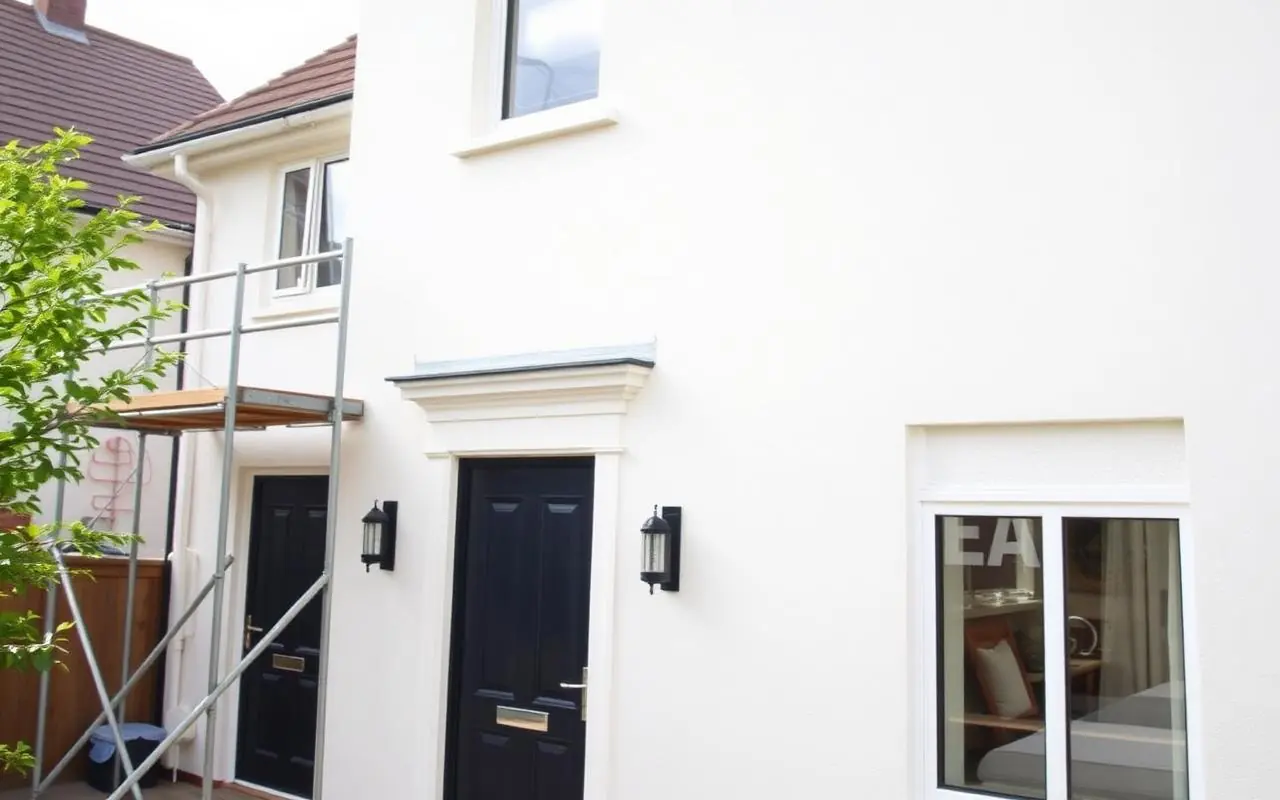
K Rend is a brand of through-coloured silicone render. Unlike traditional sand-and-cement that you paint afterwards, the colour is mixed through the finish coat, so chips and weather wear are less obvious. It is breathable, water-repellent and low-maintenance when installed on a sound, prepared substrate — and it is a common choice for exterior upgrades on homes around Sutton and nearby Surrey towns.
What K Rend actually is
K Rend is a brand of external render systems rather than a generic name for every coloured render. The product most homeowners mean is a thin-coat silicone render: a basecoat is applied to a prepared wall, reinforcing mesh is bedded in where the system or stress points require it, and a final through-coloured topcoat is trowelled or sprayed on. The colour runs through the whole finish coat, so the surface is not painted afterwards.
This is different from traditional sand-and-cement render, which is usually finished in its natural grey colour and then painted once it has cured. With K Rend, the pigment is part of the render itself, which is why small chips or scrapes are far less noticeable over time.
K Rend versus traditional sand-and-cement render
Traditional sand-and-cement render is mixed on site from cement, sand and water, applied in coats and left to cure before being painted. It is a proven system, but the painted surface will eventually need repainting, and hairline cracks or crazing can show through the paint more obviously as the surface ages.
A through-coloured silicone render carries its colour integrally. It is designed to shed water while remaining breathable, which helps the wall dry out and reduces the build-up of moisture behind the finish. Maintenance is usually limited to occasional washing to remove dirt or algae, rather than a full repaint cycle every few years.
Neither system is right for every wall. The best choice depends on the existing substrate, exposure, detailing and how much preparation is needed.
- Sand-and-cement is usually painted after curing; K Rend is through-coloured
- Integral colour makes chips and wear far less obvious
- Silicone render sheds water while allowing the wall to breathe
- Washing is normally enough to keep it looking fresh
- Both systems need sound preparation and correct application
When K Rend makes sense
K Rend is often a good choice when an existing exterior finish is tired or dated. Painted pebbledash, old sand-and-cement render that has been repainted several times, or elevations that have become stained and patchy can all be transformed with a new through-coloured silicone render.
It is especially useful on weather-facing elevations that take the brunt of rain, and on homes where the owner wants a modern, uniform finish without the repeated paint cycles that painted render needs. Whole elevations, gable ends and extensions are common applications.
When another approach is better
Not every wall needs a full re-render. If the existing finish is basically sound with only localised cracking or small blown areas, targeted repairs and a matching patch may be the more sensible and economical route.
If there is an underlying damp problem, structural movement or a failing substrate, the cause must be addressed first. Applying any new render over an active problem simply hides it temporarily. Listed buildings or those in conservation areas may also need specific materials or approvals, so always check before specifying a modern silicone system.
What the job involves on a typical Sutton house
A proper K Rend job follows a clear sequence. First the elevation is surveyed to check the condition of the existing coating and the wall beneath it. Failed or loose material is removed, cracks are opened and repaired, and any damp or movement issues are dealt with before the new render goes on.
A suitable basecoat is then applied, with reinforcing mesh bedded in at stress points and across areas the system requires. The through-coloured topcoat is applied and finished to the chosen texture. Throughout the work, windows, doors, paths and planting are protected, and the site is left clean at the end of each day. Timing depends on the weather and the size and exposure of the elevation.
Local note: Sutton, Cheam, Banstead, Carshalton and nearby Surrey
Across Sutton, Cheam, Banstead, Carshalton and the surrounding Surrey towns, we see a wide mix of older render and pebbledash finishes. Some are sound but tired; others have cracked, blown or stained over years of weathering. A site visit is the only way to tell whether a full K Rend system, a traditional re-render or local repairs are the right answer for a particular house.
You can read more about our rendering service on the Rendering and K Rend page and about local plastering work on the Sutton plasterer page. Both cover the areas and types of properties we work on most often.
Get a free quotation for K Rend in Sutton
If you are thinking about K Rend for your home, send clear elevation photographs by WhatsApp or arrange a site visit. We can assess the existing finish, discuss exposure and preparation, and give you an honest recommendation and a free quotation for the work.
Frequently asked questions
Is K Rend the same as silicone render?
K Rend is a brand that makes several render systems, including silicone render. Silicone render is a type of through-coloured, water-repellent and breathable finish. Other manufacturers make similar products, so it is worth comparing the full system specification rather than choosing by brand name alone.
Does K Rend need painting?
Through-coloured K Rend does not normally need painting because the colour runs through the finish coat. It should still be washed occasionally and inspected for damage, especially around gutters, sills and ground level.
How long does K Rend last?
A correctly applied silicone render system can last for many years, often longer than painted sand-and-cement. Lifespan depends on the quality of preparation, exposure, detailing and ongoing maintenance such as guttering and cleaning.
Can you put K Rend over pebbledash?
Only if the pebbledash is sound, stable and compatible with the proposed system. Loose or hollow areas must be removed or repaired first, and the surface may need levelling or a suitable basecoat before the through-coloured topcoat is applied. A site inspection is needed to decide whether the existing surface can stay.
Is K Rend suitable for Victorian or 1930s houses in Sutton?
It can suit some Victorian or 1930s properties, but not all. The wall construction, existing coatings, moisture behaviour and condition of the substrate must be assessed first. In some cases, particularly with listed or heritage buildings, a traditional lime or sand-and-cement approach may be more appropriate.
Need this doing?
SJF Plastering covers Sutton, Surrey and South West London. Call 07967 302162 or message us on WhatsApp for a free quotation.
What customers say
Good communication, job arranged quickly
Steve was in touch straight away, gave a very reasonable quote and was good at communicating what was needed and when he would be able to do the work. Steve arrived on time on the day, did a good job and carried out the work in very good time. I would use Steve again for any similar work.
Replacing ceiling due to leak
Steve and his team did an amazing job on our ceiling. We had to get it replaced due to a leak from the flat above and Steve was super communicative, friendly and helpful throughout.
Excellent job!
Had a large hole in the wall which Steve fixed for me, told me the price and gave other options as well all before starting the work. He did an excellent job, got the work done without any fuss!